Do “to-do” lists ever really get “done”? They seem to always be in constant flux. Things on the list change faster than our priorities do (or is it the other way around?) in Kelowna’s fast paced world, managing an endless to do list can feel like an uphill battle. Whether it’s a local ranch, vineyard, or orchard prepping for seasonal changes; Project deadlines at a local service business; Cherished family time & responsibilities, Or personal goals and ambitions, overwhelm can creep in and paralyse progress. This guide explores why overwhelm happens to us Kelownians, practical methods to tackle it, and the role of attitudes and how to make decisions that lead to efficiency and effectiveness.
As a Kelowna therapist at Unyielding Health and Wellness I often help clients navigate these challenges with empathy and tailored strategies. Let’s break it down step by step focusing on decisions that empower you.
Table Of Contents
- Is It Normal to Feel Overwhelmed at Work or in Life?
- 2. Getting So Overwhelmed That Nothing Ends Up Getting Done Despite Wanting To Get Them Done
- When You’re Feeling Overwhelmed With Work And Life And Its Impacting Your Goals And Quality Of Life.
- Methods That Help When You Are Feeling Overwhelmed at Work or in Life When you Decide to Take Action
- 1. Use a Small Notebook to Write Your Lists in and Refer Back in the Future
- 2. The Possible and Desired Task List Discovery
- 3. The Prioritised Essentials List
- 4. Assume Something Will Always Be Left Undone
- 5. Shrinking Your Context Window to Help with Overwhelm
- Healthy Attitudes Complement Your Behavioural Strategy of Making Lists
- Always ask Does Your Attitude Yield Good Results?
- Unhealthy Attitudes that Undermine Efficiency and Effectiveness
- Healthy Attitudes that Will Promote Efficiency and Effectiveness
- When Organizational Tools Aren’t Helpful: The Trap of Perfect Planning
- Watching for Signs of Overwhelm
- The Bottom Line: When You’re Feeling Overwhelmed In Kelowna
- Frequently Asked Questions When Feeling Overwhelmed
- Why Choose Unyielding Health and Wellness if You are Feeling Overwhelmed in Kelowna
Is It Normal to Feel Overwhelmed at Work and/ or in Life?
Yes, feeling overwhelmed is incredibly common and entirely normal. Can you think of anyone in your life that you haven’t seen stressed out? If someone comes to mind, I encourage you to ask them about the most stressful moment of their life! I am sure they will have a response.
Overwhelm often stems from high expectations, unexpected changes, or simply the sheer volume of tasks demanding our time and energy (which if you are reading this, you are likely aware that those are limited resources!). Sometimes, those tasks that bring us closer to our goals can be what we enjoy doing, and other times, things we ought to do (begrudgingly). As a counsellor here in Kelowna, I see many clients experiencing this due to the pressures that come with having responsibilities of balancing work, school, personal life, family, or any combination of those.
Getting So Overwhelmed That Nothing Ends Up Getting Done Despite Wanting to Get These Things Done
This is a classic sign of overwhelm. The intention is there, to finally get that thing, to be doing it, to feel that way, but the execution falters despite the desire. Your brain (flooded with tasks and loose ends) enters a state of analysis paralysis. You know what needs doing but the mental clutter makes starting feel impossible. It’s not laziness, it’s a protective response to avoid failure or burnout; It’s your brains way of saying “I need more time to assess all of this”.
When You’re Feeling Overwhelmed with Work and Life and It’s Impacting Your Goals and Quality of Life
Overwhelm doesn’t often stay contained to the specific area(s) it’s related to, it spills over into relationships, health, and well-being across many facets of life. You might experience anxiety, irritability, sleep issues, or even physical symptoms like headaches or exhaustion. If left unaddressed, it can lead to chronic stress-reduced-performance and a diminished sense of joy in daily life here in Kelowna.
There is nothing wrong with ambition, goals, the desire to be more, and have more responsibilities. However, each task and hope comes with strain and stress which accumulate and compound over time, and there are times when our ambitions can become overwhelming.
Methods That Help When You Are Feeling Overwhelmed at Work or in Life When you Decide to Take Action
Finally, some good news, right? You can regain control by deciding to act intentionally. Starting small, acknowledging the fact that this overwhelm is affecting your life more than you think is reasonable or necessary as all goals and striving often come with stress and strain. But there is a tipping point where that pressure is helpful or expected, warranted, or reasonable to a degree; Overwhelm lives on the other side of that tipping point.
Acknowledging that so far, this feeling isn’t what I set out to have, and it’s counterproductive, it’s distracting and takes away from my quality of life. Below are proven methods to shift from chaos to clarity, drawing from scientific literature, practical experiences, and my professional insights as a Kelowna therapist.
Use a Small Notebook to Write Your Lists In and Refer Back in the Future
Kidlin’s Law:
“Any problem, when divided and examined in smaller, more manageable components, becomes half as complex and overwhelming”.
In other words, if you write down a problem clearly and specifically, you have already solved half of it.
This is something I passionately use. Look phones are such amazing tools, but they are distraction magnets. It’s so easy to go onto a phone to use an app or google something (with productive intentions in mind), and get caught up doing something completely unintentional, and after a long period of time as well (darned algorithms!) Ditch digital apps for a tangible notebook/pad. Jot down tasks as they arise then review and refine them regularly. Getting organized is incredibly helpful when going through life, developing this habit, of getting the things you want to get done onto paper is that it significantly slows down the whirlwind, and provides you some anchor points to move onto the next steps beyond just the tasks name, but to begin to examine the next steps, where and how you’ll go about it.
This list is a bit different, it will never be “completed”. It will continually recycle and renew itself week by week, as things are completed and wilt, and new and/or recurring responsibilities spring up.
How to structure your list:
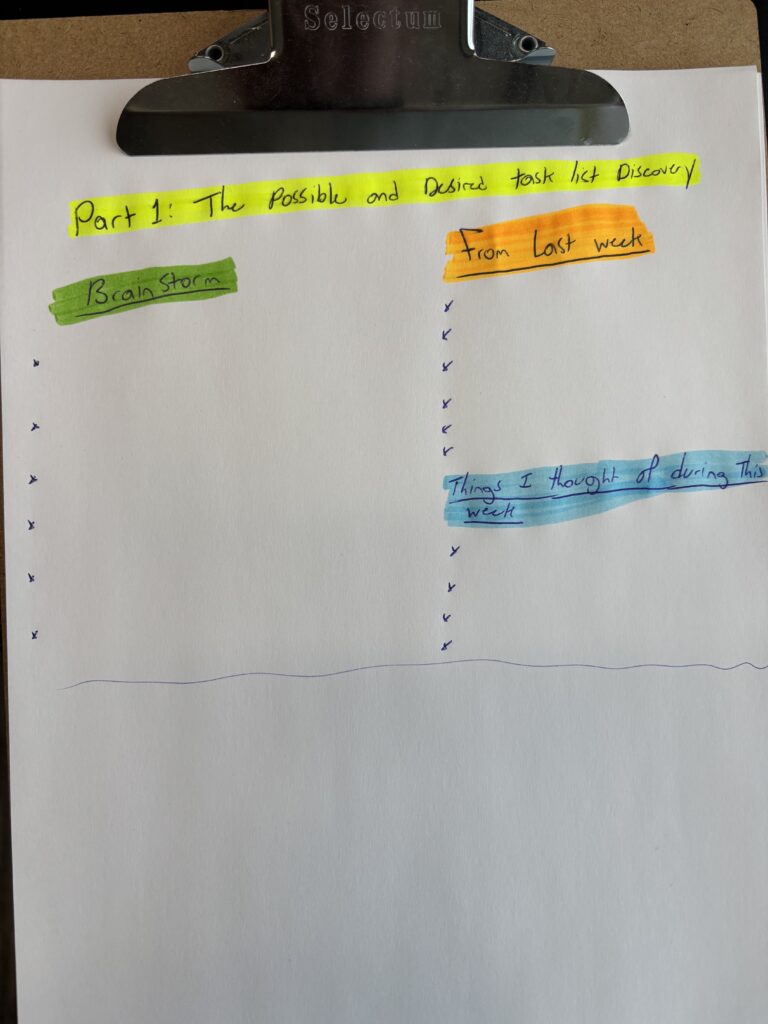
A. The Possible & Desired Task List Discovery
On Sunday (or whatever day seems like a natural reset to you)
1. Brainstorm all potential tasks for the week ahead.
2. Amalgamate tasks jotted down and left unfinished throughout that previous week. This captures old and newer ideas and keeps things top of mind.
List everything down to the finest grain you feel is needed, from getting dressed each day (hopefully prior to going out and about), grocery shopping, to career planning in this task discovery session.
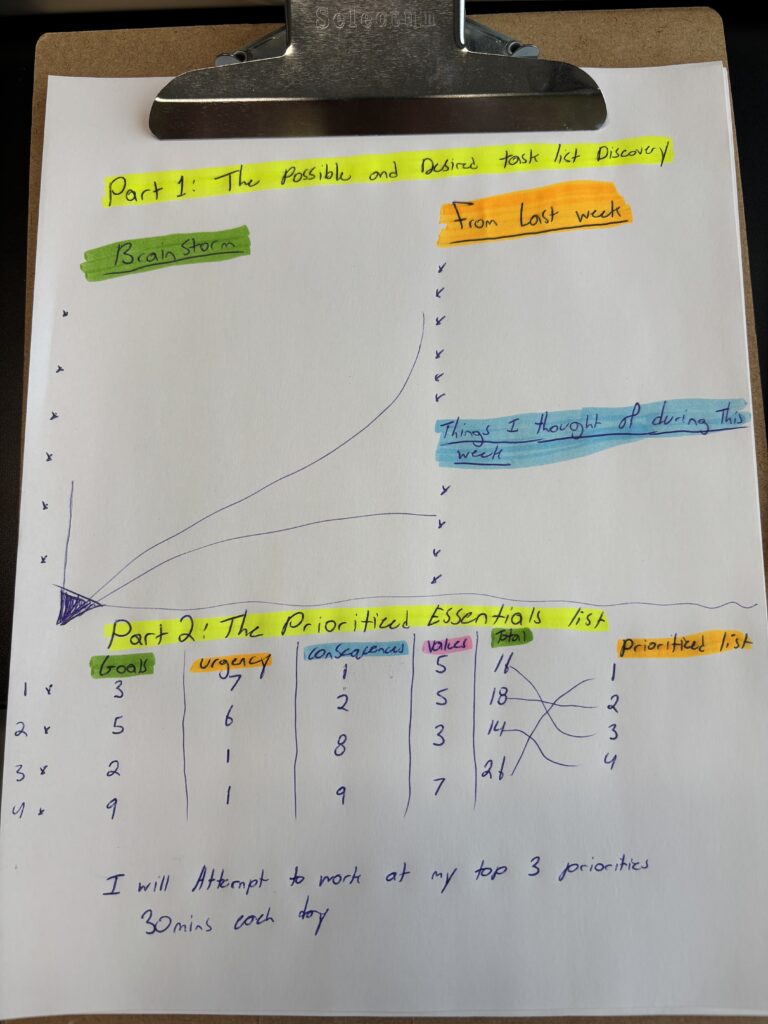
B. The Prioritised Essentials List
Now, from Part 1:
1. Select and rank the top priorities based on: relevance to goals, urgency, consequences, & personal values. Use a simple system like numbering 1-10 where 10 is significant, 1 is insignificant.
2. Target a number of tasks, or time spent on each task that you can realistically and confidently complete each day.
P.S. It is often more helpful to start small, and build momentum and confidence, than it is to start at a high number and resume that feeling of overwhelm creeping in all over again. with this in mind, it can be helpful to put a limiter on yourself. Look, you’re already feeling overwhelmed that all these things have to get done, and nothing/ or minimal is getting done in this case. Target a number of tasks that you think you can realistically and confidently complete each day. This could look like limiting the number of essential tasks to 1 a day, 3, 5, or 10 essentials per day ordered by impact. It is often more helpful to start small, and build momentum and confidence, than it is to start at a high number and restart that feeling of overwhelm creeping in again.
Assume Something Will Always Be Left Undone
Acknowledge, even the smallest of degrees, the truth in the fact that perfection is unattainable (in the moment that is, perhaps in reflection you might see the perfection in the process). Decide to focus on what truly matters letting go of the rest and the compulsion to always be productive and efficient and get everything done. This mindset frees mental energy spent toiling over being human; To demand perfection, an impossibility, and to be disappointed in ourselves when we fall short.
At the end of the day or the week review your list of what you hoped to get done and consciously mark uncompleted tasks/goals as deferred, adding them onto the most updated list as needed. If they are truly important, their priority and position on that new list will likely see them moving closer to the top, naturally.
Shrinking Your Context Window to Help with Overwhelm
Context window refers to the time you allocate to tasks. To counter overwhelm, narrow your focus into reasonable and manageable (to you!) batches. That number will be different for everyone, but if you find yourself getting bored or exhausted and unable to concentrate or be intentional with a specific task(s) after say 30 minutes, commit to only doing that task for 20 or 25 minutes, and then either take a break, or personally and my favourite, have multiple tasks running in parallel that are different from one another (blog writing vs household chores). This helps keeps things fresh for your brain, working different parts of it, and helps protect against boredom or complacency during the tasks.
This decision to limit scope reduces cognitive load and boosts completion rates and efficiency. Think of it this way: lets say you often commit to an hour of work at a time before a break, and at the start of the task your fresh and efficient, you might find that you complete over 50% of the task in the first 10-20 minutes, but as time goes on you’re ability wanes. This method essentially keeps you doing things in that peak efficiency window for more times throughout the day.
Healthy Attitudes Complement Your Behavioural Strategy of Making Lists
Tools and notebooks alone often aren’t enough, your mindset matters. Attitudes shape how you approach lists and decisions moment to moment, task by task turning strategies into sustainable habits. Show yourself kindness and forgiveness when struggling to complete your responsibilities and goals; shift from criticisms to positivity recognizing you can only do so much, and when you push yourself too hard for too long, overwhelm happens (which could be why you’re still reading this!). Everyone will have their own capacity in a given day, and for a given task. With focused and intentional practice you can certainly expand these aspects, but there is a degree of kind acceptance in where you are at right now. And taking the time to learn your own capacity and planning accordingly can go a long way to managing overwhelm.
Always Ask Does Your Attitude Yield Good Results?
Regularly reflect on the question “Is my current mindset helping or hindering my goal(s) here?”. If lists feel like a burden try adjusting your perspective to view them as allies for freedom not chains. Consider how you evaluate your days work and avoid self-critical views if you accomplish alternative tasks, or do things that your soul needs, but isn’t nessesarily “productive” in the sense you frequently mean. There is certainly some use to the behaviours and thoughts you engage in daily, they are often protective, although if you find your goals aren’t being met, perhaps you need less protection; let the curious exploring part of you have the light of day, even if for a glimpse; go do the thing and see, rather than focusing on what could go wrong.
Unhealthy Attitudes That Undermine Efficiency and Effectiveness
Perfectionism: Insisting every task must be flawless leads to procrastination and burnout. Letting perfection be the enemy of progress. Tell me, what is perfect in this world?
All or nothing thinking: “If I don’t work on this for at least an hour, then whats the point?” Resulting in inaction. Even though you could have done it for 30 mins (better than zero)
Pushing through overwhelm solely out of guilt and/or fear of shame which erodes self compassion and long term productivity. Would you want a friend to be compelled by negative or positive emotions?
Pride/ego in being overscheduled becomes a status symbol but leads to being busy without productivity, or extreme discomfort while doing so.
Healthy Attitudes That Will Promote Efficiency and Effectiveness
Self-compassion: Treat yourself kindly when things slip this builds resilience, remembering to speak with yourself as you would a friend.
Flexibility: View lists as guides not rigid rules allowing adaptation to lifes curveballs. Life can also be spelt H-A-S-S-E-L-S. Things will come up that you can and will never predict, helpful towards your goals and not so helpful at times.
Gratitude: Celebrate small wins to maintain momentum and positivity. It’s so easy to only focus on negatives, it’s just how our brains are wired. Taking even just a moment to reflect on something positive in your life can be so helpful. And if you find yourself with nothing to think of, I encourage you to watch a youtube video about someone expressing gratitude and see what happens!
Get comfortable with doing less and give yourself permission to say no to some requests for the next while. This contraction is intentional and helpful, at the moment you are clearly overstretched.
When Organizational Tools Aren’t Helpful: The Trap of Perfect Planning
Sometimes tools backfire if overused. The perfect planning trap occurs when you spend more time organising than acting endless tweaking of lists without execution. Recognise this by deciding to cap planning time. For example 15 minutes max. Shift focus to imperfect action for real progress. Tackle an unfamiliar task you’ve been avoiding to feel competent. It’s more important to do something small to then gain that shred of momentum, than to perfectly plan. Make your bed, clean up the dishes, go for a short walk.
Watching for Signs of Overwhelm
When people are overwhelmed they often display emotional, cognitive, and physical symptoms. These could include:
- Feeling forgetful or confused,
- Struggling to concentrate,
- Hesitating to make decisions,
- Making more mistakes,
- Being consumed with negative emotions,
- Not wanting to socialize,
- Sleeping poorly,
- Having low energy,
- Turning to unhealthy coping mechanisms.
All in all, this person is unable to accomplish their goals, or at the very least, is having quite an awful and uncomfortable time as they do it. There are certainly times when a person is well off to buckle down and grind for a bit, but prolonged periods of this lead to overwhelm and long term exhaustion, quite literally grinding them down.
The Bottom Line: When You’re Feeling Overwhelmed In Kelowna
Mastering your to do list is about mindful decisions at every step from acknowledging overwhelm to choosing tools and attitudes that serve you. Efficiency isn’t about doing more, it’s about doing what matters with less stress. Create an orderly routine, rest and relax, take time for favourite activities, and ask for help when needed. If overwhelm persists professional support from a Kelowna counsellor can provide personalised strategies and a space where you can sort out your priorities and where to direct your energy and spirit.
Frequently Asked Questions When Feeling Overwhelmed
How Can I Stop Feeling Overwhelmed at Work?
Prioritise tasks using lists. Say no to extra requests and build in breaks. Or if you need to prioritse work at this point, consider how you can ensure your personal life could be less demanding and more relieving.
Is it Okay to Take a Mental Health Day if I am Feeling Overwhelmed?
Yes it allows recovery. It’s like going to the gym, there will be periods of growth, mixed in with times of stability, and rest.
How Does Fear of Negative Emotions Affect Productivity?
It can lead to avoidance, but embracing and understanding these emotions can enhance creativity and determination.
Why Seek Help from a Kelowna Therapist When Feeling Overwhelmed in Life or Work?
Local experts like those at Unyielding Health and Wellness offer tailored guidance for balancing life in our community.
Why Choose Unyielding Health and Wellness if You are Feeling Overwhelmed in Kelowna
At Unyielding Health and Wellness we understand the emotional toll of overwhelm. As a Kelowna based counselling service, we help clients build resilience, prioritise effectively, and reclaim balance. Owned by Tim Lamont his empathetic and direct approach focuses on your unique needs. Ready to transform your to do list into a tool for empowerment and pride? Book a free 20 minute consultation today & make decisions that lead to a more fulfilling life.
Written by Kelowna Therapist Tim Lamont C.C.C.