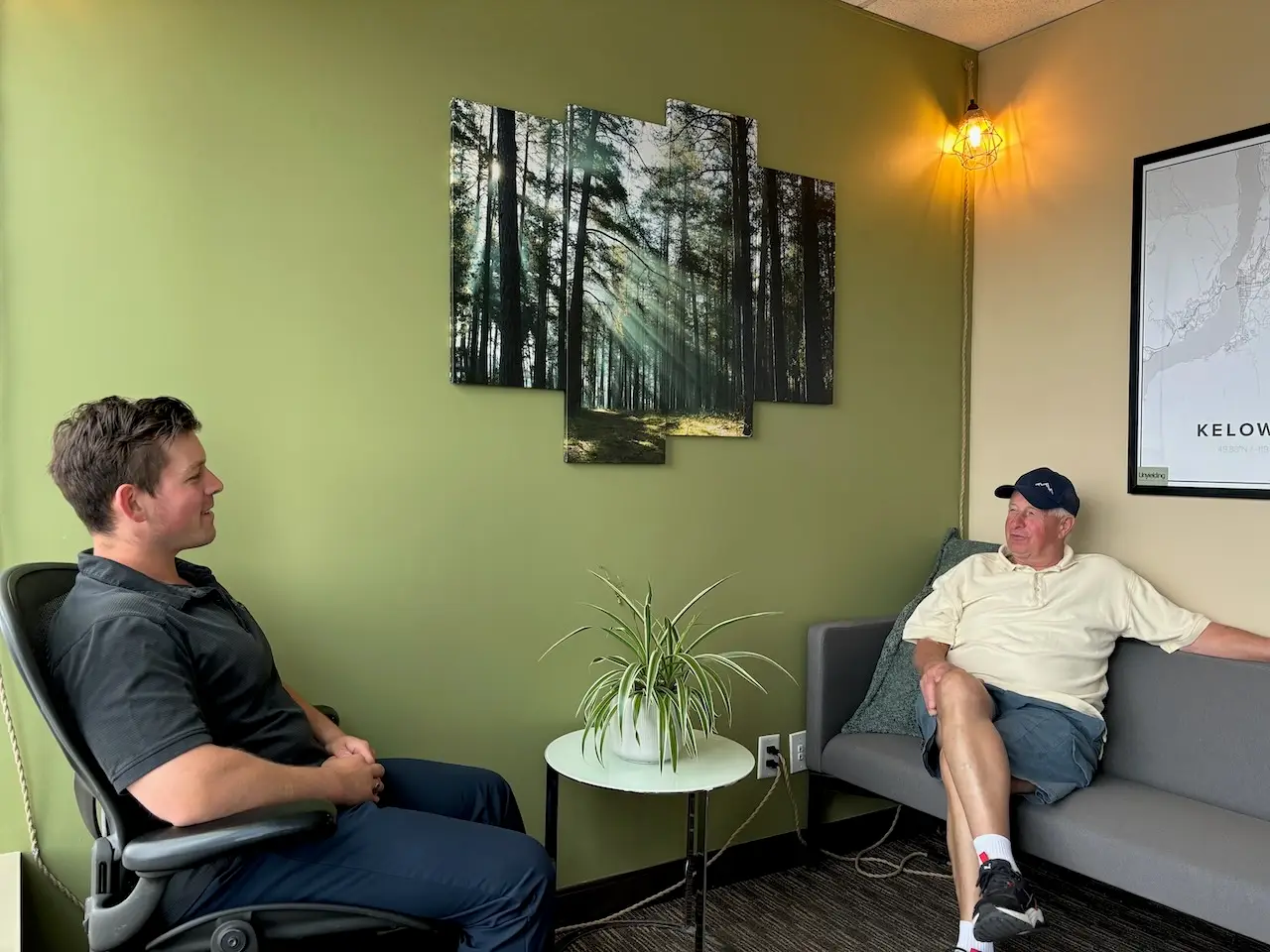
This case study highlights a hypothetical Kelowna client who sought out counselling services at Unyielding Health & Wellness in order to navigate challenges during a major life transition, as well as rediscovering their sense of purpose.
Background Information
Client
Michael: A 55-year-old retired winery manager in Kelowna, BC
Presenting Issue
Michael sought life transitions counselling at Unyielding Health & Wellness due to feelings of purposelessness and anxiety following his retirement. He expressed thoughts like, “I don’t know who I am without my job,” and struggled with a lack of direction, low motivation, and social isolation.
Michael felt overwhelmed by the shift from a structured career to an unstructured retiree lifestyle, despite initially looking forward to the freedom, it quickly faded in a manner of weeks to fearing he’d “wasted his life”. He was hesitant about attending therapy in Kelowna, believing he should be able to “figure it out alone”. After several weeks and months he decided it was time to ask for a hand to help him find meaning and confidence in his new life stage in Kelowna.
Background
Michael retired six months ago after a 25-year career managing a winery in Kelowna’s Okanagan Valley. The transition left him feeling disconnected from his identity as a leader and provider, with recurring thoughts such as, “I’m useless without my work.” He moved to a quieter Kelowna neighbourhood, which intensified his isolation, as he had few local friends outside his former workplace.
Michael’s anxiety manifested as difficulty sleeping and constant worry about his future relevance. His daughter, also a Kelownian, encouraged him to seek help, attending the initial session to support him. Michael’s goal was to find purpose, rebuild confidence, and engage meaningfully in Kelowna’s community without feeling like a “has-been.”
Therapeutic Approach
The counsellor, a Certified Canadian Counsellor (C.C.C.) with the Canadian Counselling and Psychotherapy Association (CCPA) at Unyielding Health & Wellness, used an integrative approach combining Rational Emotive Behaviour Therapy (REBT), Cognitive Behavioural Therapy (CBT), and Existential Therapy. The goals were to challenge Michael’s self-defeating beliefs, develop practical coping strategies, and help him reconnect with a sense of purpose in his retirement transition in Kelowna.
Initial Assessment
Process
- Using Existential Therapy, the counsellor explored Michael’s sense of purposelessness with questions like, “What does a meaningful retirement look like to you?” Michael identified community involvement, learning, and family connection as core values, but felt distant from them.
- With CBT, the counsellor identified cognitive distortions, such as all-or-nothing thinking (“If I’m not working, I’m worthless and/ or useless”) and overgeneralization (“Retirement means I’ve lost my purpose”).
- REBT pinpointed irrational beliefs driving his anxiety, such as, “I must always be productive to be valuable,” and “I should never feel lost.” The ABC model (Activating event, Belief, Consequence) clarified how these beliefs fueled his disengagement.
- The counsellor assessed Michael’s anxiety, noting no immediate risk but highlighting isolation as a concern. A coping plan was introduced, listing strategies (e.g., walking by Okanagan Lake, contacting his daughter once a week) and reaching out to supportive contacts like his old coworkers and friends in his old neighbourhood.
Outcome
Michael felt heard and less ashamed of his struggles. He agreed to weekly sessions for a month or two, with sessions focused on goals to reduce anxiety, rebuild confidence, and find purpose through small, values-driven steps in Kelowna.
How REBT Can Help
Goals
Challenge irrational beliefs to reduce Michael’s anxiety and sense of worthlessness, both of which foster self-acceptance and confidence in his transition to enjoying retirement to its fullest.
Process
- The counsellor used REBT’s disputing technique to challenge Michael’s belief, “I must always be productive to be valuable.” Questions like, “Does retirement mean you’re less worthy, or can value come from other areas?” helped him adopt, “I can be valuable through non-work activities.”
- The belief, “I should never feel lost,” was disputed with, “Is it realistic to expect clarity immediately after retiring?” Michael practiced rational self-statements, such as, “It’s okay to feel uncertain while I explore new paths.”
- Homework involved journaling three daily instances of value (e.g., helping a neighbor, attending a Kelowna wine tasting) and practicing self-compassion affirmations during anxious moments.
- In sessions, role-playing helped Michael counter self-critical thoughts, reframing “I’m a has-been” to “I’m discovering new ways to contribute.”
Outcome
Michael’s anxiety decreased, and he reported feeling less defined by his career, gaining confidence in exploring new roles he could pursue in Kelowna.
How CBT Can Help
Goals
Modify cognitive distortions and develop adaptive behaviors to manage Michael’s anxiety, increase engagement, and support his transition to retirement.
Process
- Using CBT, the counsellor guided Michael through thought records to reframe distortions. For example, “I’ve lost my purpose” became, “I can find new purpose, like volunteering or learning.”
- Behavioral experiments tested his fears. Michael committed to attending a Kelowna community event (e.g., a farmers’ market) to challenge, “No one will value me outside work.” He found the experience welcoming.
- A positive data log tracked achievements, such as joining a book club or gardening, reinforcing his sense of agency.
- The counsellor co-created a coping plan with strategies (e.g., mindfulness walks, journaling), reasons for staying engaged (e.g., family, Kelowna’s community), and contacts (e.g., daughter, old friends, neighbours).
Outcome
Michael increased engagement, attending three community events and starting a small garden. His anxiety dropped from 7/10 to 3/10, and he felt more in control.
How Existential Therapy Can Help
Goals
Address Michael’s purposelessness and existential concerns, aligning his actions with values to foster meaning in retirement.
Process
- The counsellor used Existential Therapy to explore Michael’s question, “What’s the point of retirement?” Asking, “What brings you meaning in Kelowna?” revealed his love for community, nature, and lifelong learning.
- Logotherapy-inspired exercises encouraged Michael to envision a fulfilling retirement, such as mentoring young winemakers or volunteering at Kelowna’s cultural festivals, aligning with his values.
- The counsellor supported small, values-driven actions, like joining a Kelowna hiking group or taking a photography class, to connect with nature and creativity, and to learn things he was interested in, but never was able to find the time for while working full time.
- Reflective discussions helped Michael accept retirement’s uncertainties as part of life’s journey, reducing his fear of being irrelevant.
Outcome
Michael reported renewed purpose, volunteering weekly at a local winery event and enrolling in a photography course. He felt more connected to Kelowna’s community.
Integration, Results, and Termination
Goals
Consolidate progress, plan for maintenance, and prepare for therapy conclusion.
Process
- The counsellor integrated REBT and CBT to reinforce rational beliefs and coping strategies. Michael practiced a “self-coaching” script for anxious moments (e.g., “I can find value in new activities”) and used thought records to manage triggers like social isolation.
- Existential Therapy helped Michael reflect on his growth, embracing community and learning as anchors of meaning. He set a goal to start a small mentoring program for aspiring winemakers in Kelowna.
- A maintenance plan included journaling achievements, continuing volunteering, and attending one community event monthly.
- The counsellor reviewed the coping plan, ensuring Michael’s confidence in using it. Follow-up sessions were offered as needed.
Results
Michael achieved significant improvements:
- Anxiety Reduction: Anxiety dropped from 7/10 to 2/10, with coping strategies providing security.
- Increased Engagement: Michael volunteered weekly, joined a hiking group, and enrolled in a photography course, boosting social connection.
- Self-Confidence and Purpose: He regained confidence in his abilities and found meaning through mentoring and community involvement.
- Resilience: Michael managed retirement uncertainties with REBT and CBT strategies, reporting a stronger sense of control.
Why This Approach Worked
- REBT: Addressed irrational beliefs like “I must be productive to be valuable,” reducing anxiety and fostering self-acceptance, key to navigating retirement.
- CBT: Provided structured tools like thought records and behavioural experiments, helping Michael manage anxiety and engage in Kelowna’s community through actionable steps.
- Existential Therapy: Tackled his existential crisis, reconnecting him with values like community and learning, fostering purpose in retirement.
- Integration: Combining REBT’s belief-challenging, CBT’s practical strategies, and Existential Therapy’s focus on meaning created a holistic approach, addressing emotional, cognitive, and existential needs.
- Local Relevance: The counsellor’s use of Kelowna-specific activities (e.g., winery events, hiking) and Unyielding Health & Wellness’s confidential environment in Kelowna’s Landmark District alleviated Michael’s hesitation, building trust.
Written By: Timothy Lamont C.C.C.
Disclaimer: The client name, details, and background used in this case study were generated with the assistance of Grok, an AI developed by xAI. AI enhances the results found within the case study, however it can make mistakes. The information and analysis presented in this case study have been critically reviewed and validated by a human therapist, who remains solely responsible for its application. Any resemblance to real persons, living or deceased, or actual events is purely coincidental. Therapists at Unyielding Health & Wellness uphold client confidentiality to the highest standard in accordance with Canadian and British Columbian privacy laws, including the Personal Information Protection Act (PIPA).